

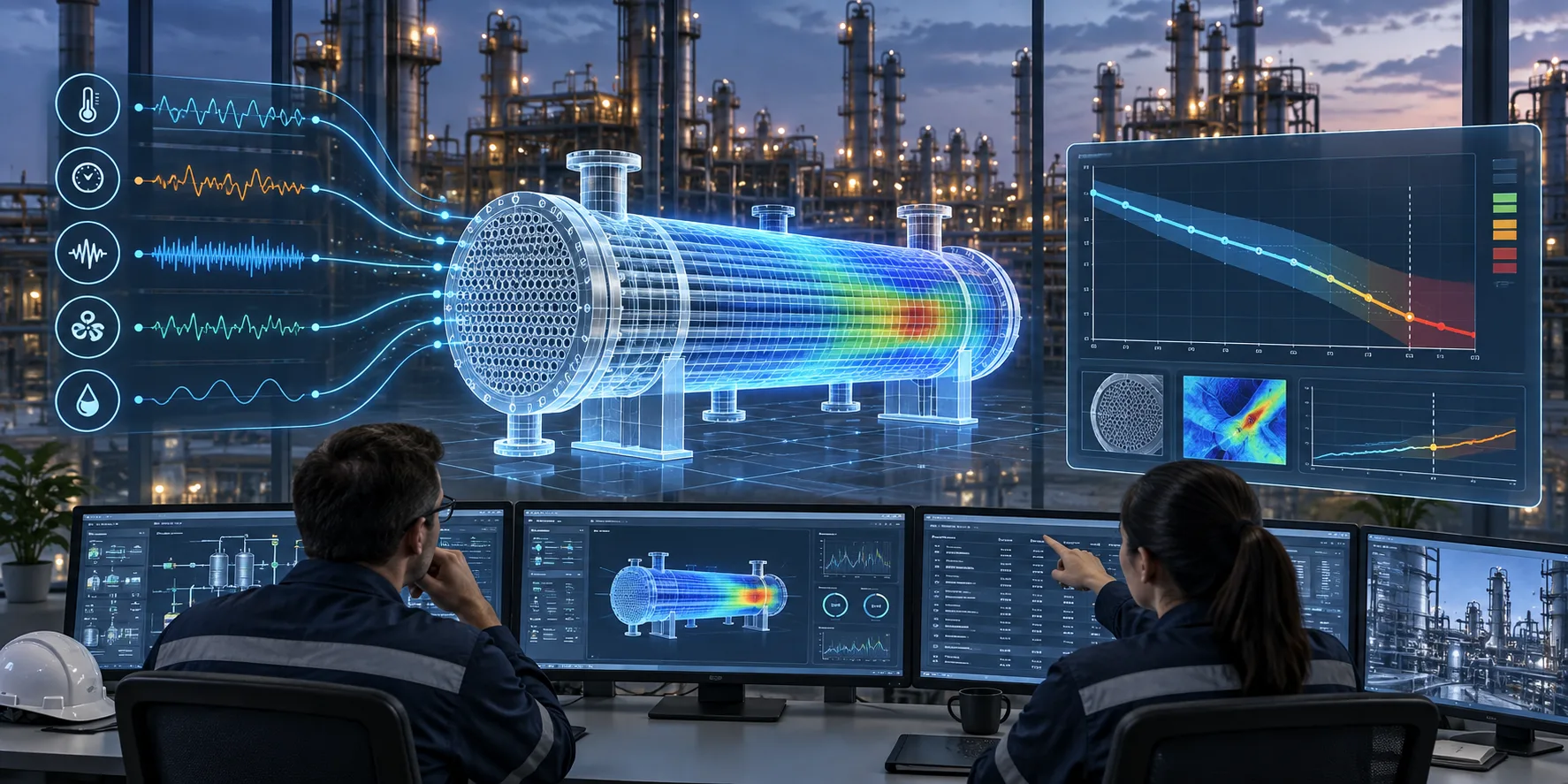
Digital twins are often described as virtual copies of physical assets, but in asset integrity work the real value is more specific: a digital twin should help teams understand current condition, simulate credible degradation, and forecast remaining life with enough confidence to support action.
For pressure equipment, piping systems, tanks, fired heaters, and rotating assets, remaining-life forecasting is not a generic dashboard exercise. It requires engineering context, inspection evidence, operating history, and an honest view of uncertainty.
What makes an integrity digital twin useful?
A useful integrity digital twin combines three layers: the asset model, the condition model, and the decision model. The asset model defines what the equipment is. The condition model estimates degradation or damage state. The decision model turns that state into inspection, repair, derating, monitoring, or replacement recommendations.
- Asset model: equipment hierarchy, design limits, materials, process service, and critical components.
- Condition model: inspection history, wall-thickness trends, defect assessment, corrosion rates, fatigue drivers, or anomaly evidence.
- Decision model: remaining life, risk level, inspection priority, recommended mitigation, and trigger thresholds.
Physics-based models and AI should work together
AI is valuable when it helps detect patterns, organize historical records, classify anomalies, or accelerate review. Physics-based models remain essential because equipment damage is governed by real mechanisms: corrosion, erosion, cracking, creep, fatigue, and thermal stress. The strongest digital twin approach combines both.
For example, a pressure vessel model may use inspection data and process conditions to estimate corrosion rate. AI can help organize the data and detect abnormal trends, while the engineering model evaluates allowable limits, remaining thickness, and inspection interval implications.
Remaining life is a range, not a single number
Remaining-life forecasts should show confidence and uncertainty. A single number can create false precision. A better forecast communicates assumptions, data quality, degradation scenarios, and sensitivity to operating changes. This helps managers understand whether to inspect, monitor, repair, or continue operation with defined safeguards.
From monitoring to action
The goal is not to build a beautiful model; the goal is to make better decisions. Digital twins should be connected to inspection planning, management of change, risk review, and maintenance execution. When the twin changes but the work process does not, the value is limited.
Logaritm AI’s digital twins and condition monitoring approach connects physics-based engineering with AI-assisted analysis so teams can move from signal to diagnosis to action.